
Views: 0 Author: Site Editor Publish Time: 2026-11-16 Origin: Site


Waiting in long lines is rapidly becoming a relic of the past. Imagine a busy commuter rushing to catch a morning train; they no longer have the patience to stand at a counter while a cashier counts exact change for a cup of coffee. Today, consumers demand instant, frictionless service at every touchpoint. This profound shift in purchasing behavior makes upgrading to an unattended payment terminal not just a luxury, but a fundamental necessity for business survival and scalable growth.
In this comprehensive guide, we will explore the underlying architecture of these automated devices, examine booming global market trends, and highlight the core operational benefits. Furthermore, you will discover actionable strategies for selecting and implementing the ideal hardware to future-proof your commercial infrastructure.
24/7 Revenue Generation: Automated systems process transactions around the clock without human intervention, effectively optimizing labor costs and extending operational hours indefinitely.
Explosive Market Growth: The global landscape for self-service technology is surging, driven by a structural shift toward contactless consumer preferences across North America, Asia, and Europe.
Versatile Applications: From snack vending machines and corporate smart fridges to ticketing kiosks and outdoor EV charging stations, these devices are actively transforming multiple commercial sectors.
Advanced Features are Crucial: Modern deployments require robust, open-source operating systems, native MDB compatibility, and top-tier PCI security standards to shield consumer data from interception.
Strategic Implementation: Long-term success requires meticulous planning, from ensuring hardware durability against harsh elements to establishing seamless, redundant network connectivity.
Establishing a clear understanding of self-service payment architecture is the essential first step toward modernizing any retail infrastructure.
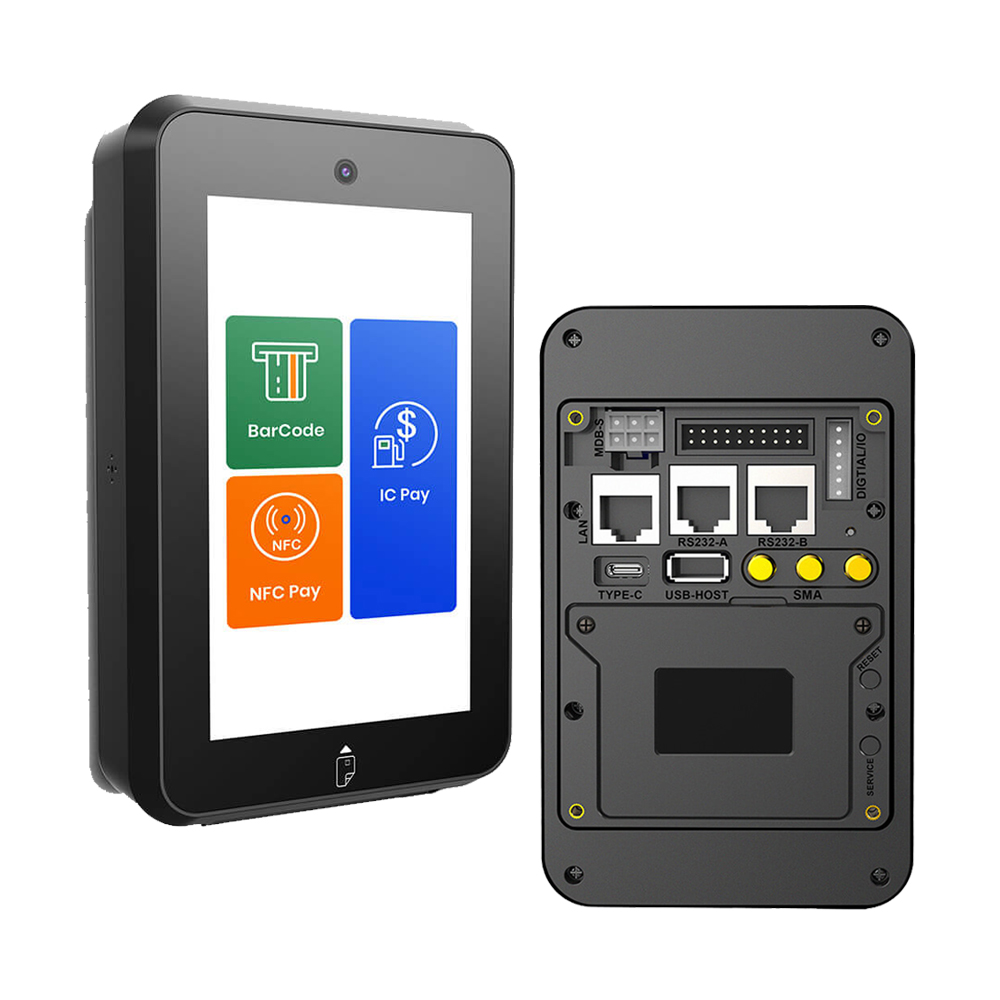
At its core, an unattended payment terminal is engineered to securely accept and process electronic payments without requiring a human cashier. These sophisticated modules handle a multitude of payment methods, ranging from traditional EMV chip cards and magnetic stripes to modern contactless technologies like Near Field Communication (NFC) for mobile wallets such as Apple Pay and Google Pay. Integrated seamlessly with cloud-based telemetry, these terminals act as the financial anchor for automated retail. They ensure that every transaction is authorized, encrypted, and settled autonomously in real-time, regardless of the physical location.
While both systems ultimately process financial transactions, their engineering, operational environments, and user interfaces differ fundamentally. Traditional Point-of-Sale (POS) systems rely heavily on a trained employee to navigate the interface, troubleshoot minor errors, and physically protect the device from theft. In contrast, unattended solutions must be entirely self-sufficient. They are tasked with guiding the consumer through the transaction intuitively while simultaneously defending against physical vandalism and severe weather conditions.
Feature | Traditional POS System | Unattended Payment Terminal |
|---|---|---|
Operating Environment | Primarily indoors, climate-controlled, supervised. | Often outdoors, exposed to extreme weather, unsupervised. |
Hardware Durability | Standard commercial-grade plastics; minimal sealing. | High IP and IK ratings; ruggedized metal enclosures. |
User Interface (UI) | Designed for employee use; complex menus. | Highly intuitive, self-guided, high-contrast screens. |
Security Architecture | Standard encryption; relies on staff presence. | Advanced anti-tamper sensors, strict PCI PTS compliance. |
The transition toward automated retail is not a speculative theory; it is a measurable, global economic shift supported by robust market data and evolving consumer behaviors. As urban centers become smarter and labor markets tighten, the demand for decentralized transaction nodes is reaching a critical inflection point.
Regional adoption rates highlight the global scale of this technology. Historically, Japan and South Korea have maintained the highest density of vending machines per capita, pioneering the early integration of cashless transit cards. However, the United States is currently experiencing a massive acceleration in unattended infrastructure. Driven by the expansion of self-service kiosks in quick-service restaurants, automated car washes, and smart micro-markets, the US market is scaling rapidly to meet the demands of a convenience-driven consumer base.
Several macroeconomic factors are pushing the market forward. First, the post-pandemic landscape established contactless payments as the baseline expectation for both hygiene and speed. Second, rising global labor costs have forced operators to rethink operational expenditure. Modern retail strategy is shifting toward "Automation First," where human capital is reallocated to high-value customer interactions, while routine transactions are delegated to reliable hardware.
Industry analysts note that as urban infrastructure becomes more interconnected, these devices are evolving into intelligent IoT nodes. They communicate directly with inventory supply chains, pushing the compound annual growth rate of the sector to record heights.
The inherent versatility of self-service payment hardware allows it to be deployed across a wide spectrum of industries, solving unique operational bottlenecks in each specific vertical.
Traditional coin-operated machines are becoming obsolete, often frustrating users with rejected bills or jams. By retrofitting legacy machines with an unattended payment terminal, operators can capture sales from the growing demographic of cashless consumers. In smart fridges placed in corporate breakrooms, these terminals facilitate a seamless "grab-and-go" experience that eliminates mechanical failures.
In environments where transaction speed is critical, automated terminals are indispensable. Quick-service restaurants utilize self-ordering kiosks to reduce wait times and increase order values through automated, visually appealing upselling. Similarly, transit stations and cinemas rely on these systems to manage high volumes of foot traffic during peak rush hours, maintaining high throughput without the need for additional front-counter staff.
As the global infrastructure for electric vehicles expands, the need for frictionless payment has become paramount. Drivers expect a simple pay-as-you-go model rather than downloading proprietary apps. Ruggedized terminals integrated into charging stations and on-street meters ensure reliable revenue collection regardless of harsh environmental conditions.
Investing in automated payment infrastructure yields measurable returns on investment through both revenue enhancement and significant cost reduction.
The most immediate benefit is the removal of operating hour constraints. Automated transactions allow businesses to generate revenue 24 hours a day, 365 days a year. Whether it is a late-night traveler purchasing a travel essential or an early commuter using a charging station, businesses can process sales while the facility is effectively closed, capturing off-peak revenue.
Labor represents one of the largest, most unpredictable expenses for any retail business. By delegating the repetitive task of transaction processing to an unattended payment terminal, companies can reduce the number of cashiers required. This allows management to reallocate staff toward tasks like facility maintenance and inventory management, improving overall efficiency.
Modern consumers prioritize speed above all else. Terminals that accept tap-to-pay and mobile wallets reduce checkout friction. By eliminating the need to wait for a human cashier to process a receipt, businesses shorten queues and increase customer throughput. A faster, more intuitive checkout process directly correlates with higher customer satisfaction and brand loyalty.
Selecting the correct hardware is a critical operational decision. Deploying an outdated system can lead to integration failures and frequent downtime.
Historically, terminals utilized proprietary operating systems that limited functionality. Today, enterprise-grade devices leverage open-architecture platforms like Android 14.0. This allows operators to deploy custom applications and run digital advertising during idle states, providing a user experience that mirrors a modern smartphone.
For the vending industry, hardware interoperability is a primary concern. The Multi-Drop Bus protocol is the universal standard for communication between a vending machine controller and peripheral devices. When upgrading, native MDB compatibility ensures a plug-and-play experience, communicating transaction data directly to the machine’s computer without the need for unstable pulse converters.
A commercial-grade terminal must hold the latest PCI PTS certification. Furthermore, the hardware should utilize Point-to-Point Encryption to ensure cardholder data is shielded the moment it touches the reader. Additionally, environmental resilience is a key differentiator; look for IP65 ratings for water protection and IK08 ratings for impact resistance to ensure longevity in high-traffic or outdoor areas.
Successful deployment requires strategic planning, from site assessment to software management. Following a standard integration framework is the best way to prevent common pitfalls.
Operators must conduct a thorough site survey before installation. Terminals placed in direct sunlight require high-brightness screens, while those in high-crime areas may need specialized protective housing. Identifying these variables early prevents hardware damage and ensures optimal performance.
An automated device is dependent on network connectivity; dropped connections mean lost sales. While Ethernet provides the most stable connection, cellular connectivity with multi-carrier SIM cards is the industry standard for kiosks. This redundancy ensures that the terminal automatically switches to the strongest network available, maximizing uptime.
Managing a fleet of dispersed terminals manually is logistically impossible. Integration of a cloud-based Terminal Management System is essential. This dashboard allows operators to track real-time sales and push over-the-air software updates, reducing the need for expensive on-site technician dispatches.
A phased deployment strategy mitigates financial risk. Installing terminals on a small subset of machines allows the team to identify integration bugs and verify that funds are settling correctly before executing a large-scale rollout.
The transition toward self-service commerce is a permanent structural shift. As consumer expectations evolve, the technology powering these systems will continue to advance, offering revolutionary ways to engage customers. Artificial Intelligence is already being integrated to facilitate dynamic pricing, while biometric authentication is poised to replace physical cards in closed-loop environments. By bridging the gap between automated hardware and personalized retail, operators can deliver the seamless experiences that future consumers will demand.
By lowering operational costs and eliminating the need for constant supervision, automated systems drive daily transaction revenue while meeting the demand for contactless checkouts. From retrofitting legacy vending machines to powering new infrastructure, the versatility of this technology is reshaping the retail landscape. Operators are encouraged to evaluate their current infrastructure today; integrating advanced, ruggedized hardware is the definitive key to future-proofing operations and maintaining a competitive edge.
Modern terminals accept a wide variety of methods, including EMV chip cards, magnetic stripes, and contactless options like Apple Pay, Google Pay, and NFC-enabled credit cards. Some advanced models also support QR code scanning for specialized loyalty programs or promotional redemptions.
Yes. High-quality terminals are equipped with rigorous security standards, including PCI PTS compliance, end-to-end encryption, and physical anti-tampering sensors. These sensors are designed to automatically wipe cryptographic keys if the machine is forced open or physically compromised.
Yes, provided the terminal supports standard MDB protocols. This allows the terminal to communicate directly with the vending machine controller, modernizing older units for cashless payments without requiring a full machine replacement.
Most units offer multiple connectivity options to ensure consistent processing, including 4G/5G cellular modules, dual-band Wi-Fi, and hardwired Ethernet. Cellular connections with multi-carrier roaming are recommended for remote locations to ensure maximum uptime.
Maintenance is minimal due to durable, weather-resistant designs with high IP and IK ratings. Software management is typically handled remotely via a cloud-based dashboard, which allows operators to monitor health, perform troubleshooting, and push updates without needing to visit the site.
